


The Social Dilemma- The Ethics Behind Social Media
- J.J. Ward

- Apr 9, 2021
- 3 min read

Have you ever watched a documentary that has made you want to stop participating in whatever inhumane topics the film covers, only for you to forget to change your behavior after a couple of days? This week I watched "The Social Dilemma", a docudrama that reveals the horrors of social media and the power the companies that created the platforms hold. After watching the film, you might long for the days before smartphones.

Personally, I do not have any social media and I have not had it for a while. I deleted my apps a couple of years ago and have never looked back. I often had people question how I could major in Public Relations but have a personal disdain for social media. I explained it away by saying that creating personal content is a lot different than creating content for a business or organization. Business social media seemed like a way for people to receive information, personal social media felt like a need for validation I no longer wanted to be dependent on. So, when I was going to watch this film I felt pretty safe, that nothing they could say would phase me. I could not have been more wrong.
One of the big issues I had learned from the film was that the ways these platforms are built, and run are made to tap into the addictive nature of humanity. These companies have figured out how to create a situation that causes the release of dopamine, which can be a very addictive feeling. After all, who doesn't want to feel happy?
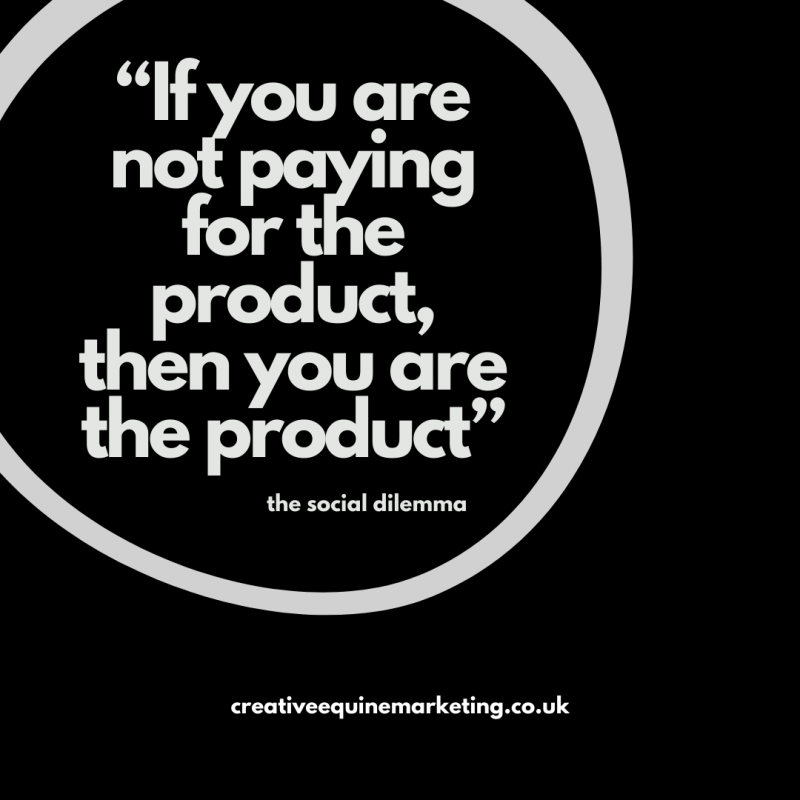
They achieve this through constant notifications that pull you into your device and keep you there. That's the difference between these platforms and the tools we use would use in Public Relations. The tools we use create content that we have to find a way to distribute. These platforms try to actively intrude into people’s lives.
So, how do I look at this through a Public Relations lens? How does this change how I reach my target audiences? I think it has to come down to your own personal morals. After watching this film, I would be lying if I said I wasn't aware that by using social media platforms to engage with audiences I would be part of the problem. However, convincing a company or organization to connect with an audience through other means can be difficult as it can be expensive, time consuming, and overall, less effective. So, you have to decide if you are okay with knowing that you are being a cog in the social media machine or if you are willing to go down a more difficult path where the end goal might not be achieved.

Whichever stance you choose to take, the least you can do is fight against the core problem in social media that the experts in this film bring to light. That problem is that we are unable to find the truth within social media. Tristan Harris put it simply saying, "If we cannot agree on what is true then cannot navigate out of any of our problems." In the end the truth is something that we can give at no costs to ourselves.
So, where does this leave me as I am about to enter the world of Public Relations? It makes me cautious to suggest heavy usage of social media for campaigns. I know suggestions like that will be met with resistance, after all customers lives revolve around it. It would be a hard sell to convince a company to not engage on social media, especially if that company values profit over people. When it comes down to it, I know the most I can do is educate my clients and suggest that they limit their platforms. In the end it will come down to whatever my client wants to do because it is their name and not mine. I will just have to decide my morals early on and know where I draw the line.
As for my personal use, I do not really see anything changing. I don't have any social media now and I don't believe I will want it ever again. After all the experts in the film avoid it and I have always been one to trust a reliable expert.


Comments